What Can AI Learn From a Surgical Video? A Look Inside Surgical Annotation

A surgical video contains far more information than most people realize. What appears to be a routine procedure on screen is actually a continuous sequence of decisions, actions, anatomical observations, safety checks, and clinical judgments. Surgeons understand these signals because they have spent years learning how to interpret them. AI systems start with none of that context.
A model watching a laparoscopic procedure does not know whether a surgeon is exposing anatomy, dissecting tissue, controlling bleeding, or preparing to clip a critical structure. It cannot identify which instrument is being used, which organ is visible, or whether an important surgical milestone has been achieved.
All of that understanding has to be taught through data.
This is where surgical video annotation becomes one of the most specialized forms of surgical data annotation for medical AI. The objective is not simply to label objects inside a frame. The objective is to convert surgical procedures into structured information that AI systems can learn from.
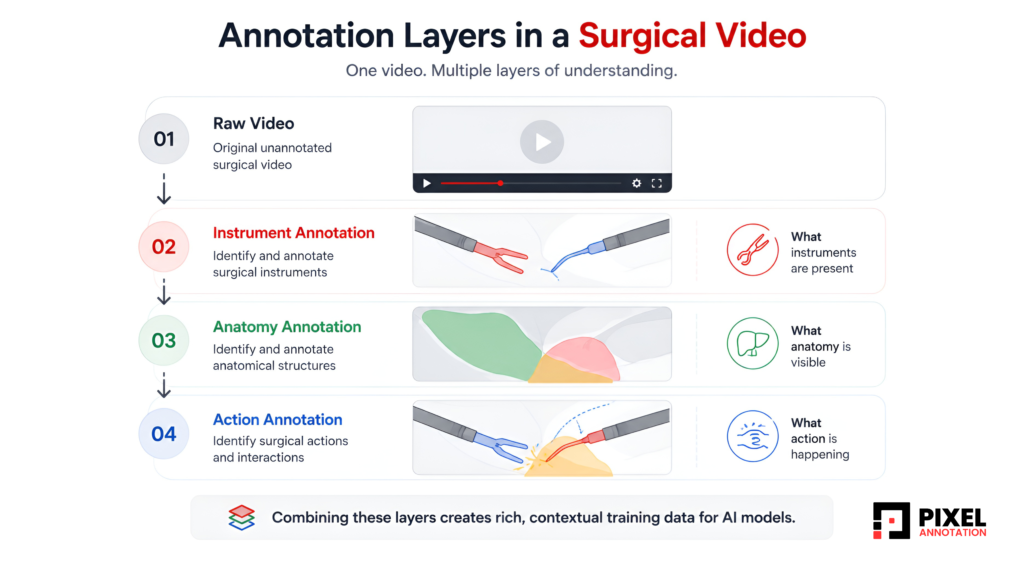
The interesting part is that a single surgical video can be annotated in multiple ways simultaneously. Each annotation layer teaches the model something different about the procedure.
#Understanding the Surgical Workflow
Before an AI system can understand what a surgeon is doing, it first needs to understand where the procedure currently stands.
Every surgery follows a workflow. While techniques may vary between surgeons, most procedures progress through a series of recognizable stages. Depending on the procedure, these stages can include access, exposure, dissection, clipping, transection, specimen removal, inspection, and closure.
Workflow annotation focuses on identifying these procedural phases and defining the precise boundaries between them.
At first glance, this may seem straightforward. In practice, it often becomes one of the most challenging annotation tasks.
Surgical phases rarely change with a clean visual transition. A surgeon may spend several minutes preparing for the next step while still technically operating within the current phase. Instruments may be exchanged. Tissue may be repositioned. Visibility may temporarily disappear because of smoke, blood, or camera movement.
The challenge is determining exactly when one phase ends and another begins.
When performed correctly, workflow annotation helps AI systems develop procedural awareness. Instead of viewing surgery as a collection of independent frames, the model begins to understand the procedure as a sequence of clinically meaningful events.
This capability is increasingly important for surgical analytics, operating room efficiency studies, workflow monitoring, automated reporting, and context-aware surgical assistance systems.
#Teaching AI to Recognize Surgical Instruments
Once an AI model understands where it is within a procedure, the next layer is understanding which tools are being used.
Instrument annotation is one of the most common forms of surgical video annotation. Depending on the project, instruments may be labeled using bounding boxes, polygons, instance segmentation masks, or tracking annotations.
Common examples include:
- Graspers
- Scissors
- Hook cautery instruments
- Bipolar forceps
- Clip appliers
- Suction and irrigation devices
- Needle drivers
- Staplers
The challenge is that surgical instruments rarely appear in ideal conditions.
A tool may be partially hidden behind tissue. Smoke from energy devices can obscure visibility. Blood, fluid, glare, and reflections often affect image quality. Two instruments that look distinct when fully visible may appear nearly identical when only a small portion of the tool is visible.
This is why annotation consistency becomes critical.
The AI is not learning from a few perfect examples. It is learning from thousands of real surgical scenarios where instruments appear from different angles, under different lighting conditions, and in varying states of occlusion.
Beyond simple recognition, these annotations also support instrument tracking, usage analysis, surgical skill assessment, and procedure understanding.
#Mapping the Anatomy Inside the Surgical Field
Understanding instruments is only part of the story.
Surgical AI systems must also understand the anatomy those instruments interact with.
Anatomical annotation can include:
- Organs
- Blood vessels
- Ducts
- Nerves
- Tissue planes
- Anatomical landmarks
- Pathological structures
This is often where surgical data annotation for medical AI becomes significantly more complex than annotation projects in other industries.
Unlike everyday objects, anatomy rarely presents perfect visual boundaries.
Structures may be partially covered by surrounding tissue. Important anatomical landmarks can emerge gradually as dissection progresses. Blood, smoke, surgical debris, and fluid frequently obscure portions of the anatomy.
A structure may be anatomically present but not visually distinguishable enough to annotate confidently.
Experienced annotation teams learn to follow a simple principle:
Annotate what is visible, not what is assumed.
That distinction plays a major role in creating reliable training data. Models trained on inferred anatomy often learn inconsistent patterns, while models trained on visually verifiable anatomy develop stronger generalization capabilities.
#Capturing Surgical Actions and Tool-Tissue Interactions
Recognizing instruments and anatomy is valuable, but it still doesn’t explain what is happening inside the procedure.
A grasper holding tissue and a grasper repositioning tissue are not the same action.
A pair of scissors entering the field does not necessarily mean tissue is being cut.
This is where action annotation becomes important.
Depending on the project, annotations may capture:
- Grasping
- Retracting
- Cutting
- Dissecting
- Clipping
- Suturing
- Coagulating
- Stapling
- Irrigating
- Aspirating
The interesting part is that many surgical actions cannot be identified from a single frame.
They require temporal understanding.
A clip applier positioned near a duct and a clip successfully deployed on that duct may look similar in one frame. The distinction becomes clear only when the surrounding sequence is analyzed.
For AI systems focused on surgical understanding, action annotations provide essential context that static object labels cannot capture.
#Identifying Critical Surgical Events
Not every moment in a surgery carries the same significance.
Some events may last only a few seconds yet represent critical milestones within the procedure.
Examples include:
- Identification of key anatomical landmarks
- Completion of safety checkpoints
- Vessel clipping
- Tissue transection
- Staple deployment
- Device insertion
- Bleeding events
- Specimen extraction
- Procedure-specific safety confirmations
These events are often among the most valuable annotations within a dataset.
Many surgical AI applications are designed specifically to recognize important moments and provide insight around them.
For example, workflow systems may identify when a procedure reaches a particular milestone. Quality assurance systems may evaluate whether specific safety steps were completed. Training platforms may use event annotations to compare procedural techniques across surgeons.
Accurately identifying these events requires both annotation expertise and domain knowledge.
The challenge is rarely drawing the annotation itself.
The challenge is understanding what the event represents clinically.
#Annotating Visibility, Occlusions, and Difficult Cases
One reality of surgical video annotation is that surgeries are rarely recorded under perfect conditions.
Visibility changes constantly throughout a procedure.
Annotators routinely encounter:
- Smoke from energy devices
- Blood obscuring anatomy
- Lens contamination
- Motion blur
- Camera repositioning
- Instrument overlap
- Tissue occlusion
- Out-of-frame structures
These situations create some of the most important decisions within the annotation process.
Should a partially visible structure still be annotated?
Is an anatomical boundary visible enough to segment accurately?
Has the instrument actually left the field, or is it temporarily hidden?
These questions often have a greater impact on dataset quality than the straightforward examples.
This is why surgical annotation projects depend heavily on detailed guidelines and quality control frameworks. Without clear standards, two annotators may interpret the same frame differently, leading to inconsistent training data.
In medical AI, consistency is just as important as accuracy.
#Why Domain Expertise Matters in Surgical Annotation
Many annotation projects can be learned quickly.
Surgical annotation is different.
Even highly experienced annotators require procedure-specific training before they can work on a medical dataset confidently.
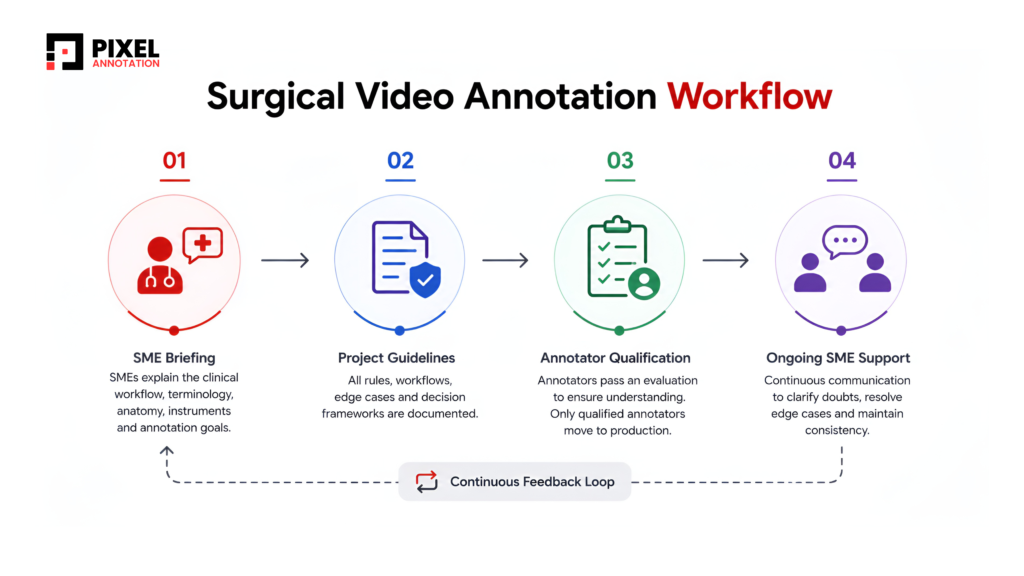
At Pixel Annotation, domain-specific projects begin long before the first annotation is created.
- The process starts with subject matter experts reviewing the project requirements and explaining the clinical workflow, terminology, anatomy, instruments, and annotation objectives to the team.
- Every workflow, annotation rule, edge case, and decision framework is documented through detailed project guidelines. Annotators are expected to review and understand these materials before participating in production work.
- Before joining the project, annotators complete an evaluation designed by the SME team. This assessment validates their understanding of the procedure, annotation requirements, and project-specific edge cases.
- Only annotators who achieve the required qualification score move forward into production.
Even after annotation begins, the connection with SMEs remains active. Questions inevitably arise when dealing with complex anatomy, unusual surgical techniques, or difficult visibility conditions. Regular communication channels allow annotators to escalate uncertainties, clarify edge cases, and maintain consistency across the dataset.
This approach helps ensure that annotations remain aligned with both the project requirements and the underlying clinical context.
#From Surgical Videos to AI Training Data
A surgical video may appear to be a simple recording of a procedure.
For an AI system, however, it represents a collection of interconnected learning signals.
A single video can contain:
- Workflow annotations
- Instrument annotations
- Anatomical annotations
- Action labels
- Event markers
- Tracking data
- Visibility states
- Quality review metadata
Each layer teaches the model something different.
Workflow annotations teach procedural understanding. Instrument annotations teach object recognition. Anatomy annotations teach spatial awareness. Action annotations teach behavior. Event annotations teach clinical significance.
Together, these layers transform raw surgical footage into structured training data capable of supporting the next generation of medical AI systems.
The most capable surgical AI platforms are not built by collecting large numbers of videos. They are built by teaching models how to interpret every meaningful detail within those videos.
That understanding begins with high-quality annotation.