
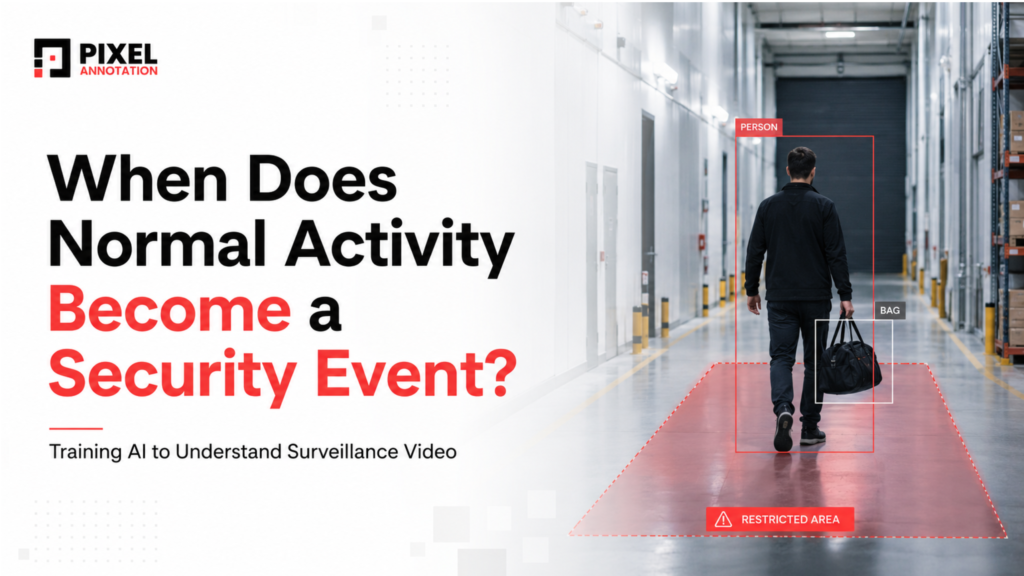
When Does Normal Activity Become a Security Event? Training AI to Understand Surveillance Video
When Does Normal Activity Become a Security Event? Training AI to Understand Surveillance Video A security camera can see a person walking through a corridor without any trouble. That is the easy part. The harder question is what the system should actually understand from that movement. Is the person simply passing through, or did they enter an area they should not be in? Have they been standing near an access point long enough for it to matter? Did they leave that bag beside them intentionally, or are they coming back for it? And if they walk behind a parked van and appear again a few seconds later, is it even the same person? These are very different security situations, even though the camera sees roughly the same things each time ; a person, a doorway, a bag, maybe a vehicle passing through. This is exactly where security and surveillance annotation goes beyond simply drawing boxes around objects. To train a system that understands what is actually happening, the dataset needs to capture several things at once: Object annotation teaches a model what’s in the scene. Event annotation teaches it what the scene means. That second part is where most of the difficult decisions begin. 1. Spotting a Person Is Easy. Understanding Them Isn’t. Most security AI systems start with fairly basic visual understanding ; spotting people, vehicles, bags, doors, gates, fences, equipment, and restricted areas within a frame. With image annotation for security and surveillance, all of this can be marked using bounding boxes, segmentation masks, keypoints, or attributes, giving the model clear and reliable ground truth. A box around a person tells the model, in simple terms, that there is a person there. But a real security system usually needs to answer something more useful: what is this person actually doing, and does it matter? A person standing near a warehouse entrance is completely normal. The same person standing inside a restricted loading area might not be. Someone holding a bag is unremarkable; a bag left behind after they have walked away can become a genuine security event. Consider how differently the same basic objects can be understood depending on context: This is why two annotators can agree perfectly on a person’s bounding box and still disagree completely about what event, if any, is taking place. The object-level annotation can be accurate while the security interpretation behind it is wrong ; and that distinction affects almost every serious security data annotation project from the beginning. 2. Where It Happens Decides What It Means Before a system can flag an intrusion, it needs to know where that intrusion can actually happen. This is why most surveillance datasets include virtual zones, usually drawn once for a fixed camera and then used to interpret everything the camera tracks afterward: Drawing a shape around a restricted area sounds simple enough. The real difficulty is deciding exactly when someone has “entered” it. Suppose a worker walks up to the boundary and one foot crosses the line ; does that count? What if they reach across the boundary but keep their body outside it? What if the camera angle makes their bounding box appear to overlap the zone, even though they are physically standing outside it? These are not rare or hypothetical situations. They are exactly the kind of cases that create inconsistent labels when a project has not defined its rules clearly enough. Because of this, every project needs one clear, agreed-upon crossing rule. A few of the common ones we work with: There is no single rule that works everywhere ; a high-risk industrial area may need a very sensitive threshold, while a wide public entrance might need something more flexible. What matters far more than which rule is chosen is that everyone on the team applies the same one. A zone only becomes useful once everybody agrees on what interacting with it actually means. 3. One Person, One Story: Why Tracking Holds the Whole Event Together A security event almost never exists inside a single image ; it develops over time, which is exactly why video annotation for security and surveillance matters so much. Picture a person walking through a facility: the system detects them in frame one, then frame two, then frame three. A tracking ID tells the model that all three detections belong to the same person, and that continuous identity allows the system to understand movement instead of treating every frame as a separate scene. Here’s why that matters in practice. Suppose someone is tracked correctly for 150 frames, then walks behind a parked van and disappears. Three seconds later, they come back into view. If the annotator gives them a brand-new tracking ID after that gap, the individual boxes might still look perfectly correct ; but the event itself has quietly been split into two. Instead of recording one person moving through the scene, the training data now says one person disappeared and a different person appeared. That kind of break can affect: Tracking therefore needs its own set of rules ; how long an ID should remain active during an occlusion, when a track should be considered finished, when a new ID is genuinely needed, how to handle two people crossing paths, and what to do when re-identification is uncertain enough that it should go to a human reviewer instead of being guessed. A box can be completely correct in every single frame while the track connecting all of those boxes is wrong ; which is exactly why video quality checks cannot be done by looking at isolated frames one at a time. 4. The Clock Is Part of the Label Some security events are not defined only by what a person does, but by how long they keep doing it. Loitering is the clearest example. A person standing near an entrance for ten seconds is normal. Thirty seconds is probably still fine. Five minutes might be worth a second look ; but even that is