Egocentric Data Annotation: Teaching AI to See the World Like a Human
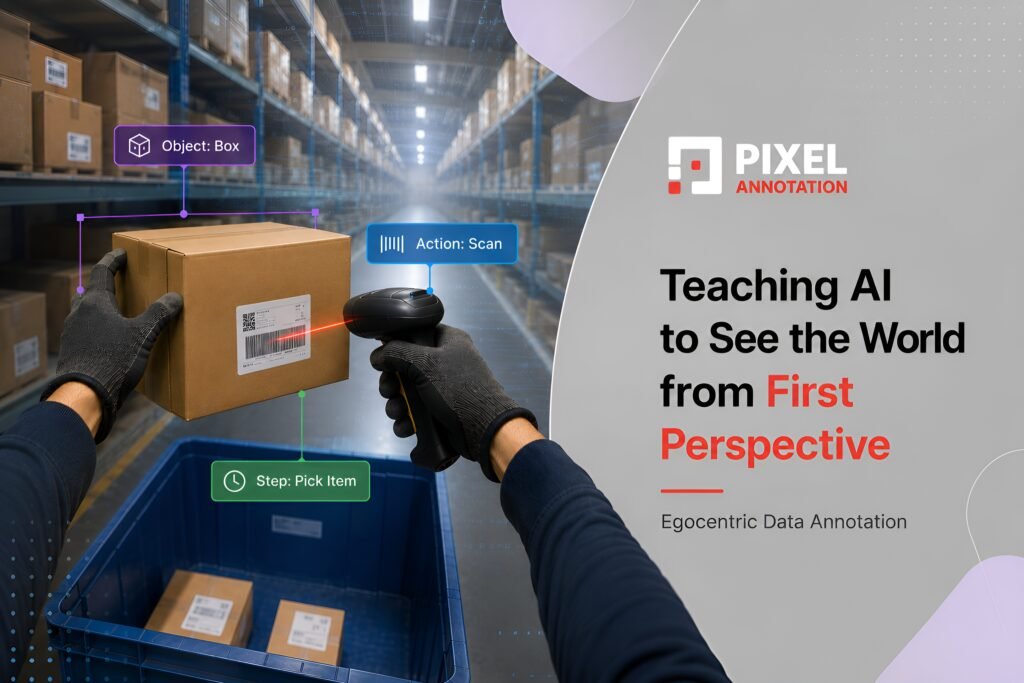
Most AI systems learn by watching humans.
- A camera mounted above a factory floor observes workers.
- A dashcam records the road ahead.
- A broadcast camera captures athletes from the sidelines.
In all of these cases, the AI sits outside the action, learning by observing the world from a distance. But a new generation of AI systems is being built differently.
Instead of watching humans from the outside, these systems need to understand the world from the exact perspective of the person performing the task.
- What does the person see?
- What are they interacting with?
- What are they trying to accomplish?
- What are they likely to do next?
This is the foundation of egocentric AI, and the data that powers it is fundamentally different from traditional computer vision.
Accurate training datasets created through image annotation services are essential for developing AI systems that can handle complex real-world tasks.
#What Is Egocentric Data?
Egocentric data, also known as first-person data, refers to visual, audio, and sensor information captured from the perspective of the person or agent performing an activity.
Instead of observing someone from the outside, the AI experiences the world exactly as they do. The objective is no longer simply to identify objects.
The objective becomes understanding:
- What is the person doing?
- Why are they doing it?
- What are they interacting with?
- What happens next?
- How is the overall task being performed?
This shift transforms computer vision from scene understanding into human behavior understanding.
#Common Types of Egocentric Data
Egocentric data can be collected from a wide range of devices and environments.
– Smart Glasses
Smart glasses capture real-time first-person experiences and are increasingly used for:
- Context-aware AI assistants
- Human activity understanding
- Remote support
- Augmented reality applications
– Head-Mounted Cameras
Head-mounted cameras are widely used in:
- Manufacturing
- Construction
- Industrial inspections
- Field operations
- Sports training
They provide a natural first-person view of human workflows.
– Body-Worn Cameras
Body-worn cameras capture:
- Worker activities
- Safety procedures
- Task execution
- Human-environment interactions
- Operational workflows
– Surgical Head Cameras
In healthcare, first-person surgical recordings capture:
- Surgical workflows
- Instrument interactions
- Procedure phases
- Hand movements
- Clinical decision-making
– AR/VR Headsets
AR and VR devices capture:
- User gaze
- Hand interactions
- Object manipulation
- Spatial understanding
- Immersive task execution
– Robot-Mounted Cameras
Robots increasingly learn tasks from their own perspective using:
- RGB cameras
- RGB-D cameras
- Stereo cameras
- Wearable sensors
These datasets are fundamental for:
- Embodied AI
- Robotic manipulation
- Imitation learning
- Human-robot collaboration
– Multi-Modal Wearable Systems
Modern egocentric AI systems often combine:
- Video
- Audio
- Gaze tracking
- IMU sensors
- GPS
- Hand pose information
- Body motion data
- Environmental sensors
This allows AI systems to learn not only what humans see, but also how they move, interact, and make decisions.
#What Makes Egocentric Data Different?
At first glance, egocentric data seems simple.
Move the camera from a fixed position to a person’s head.
But that single change transforms everything.
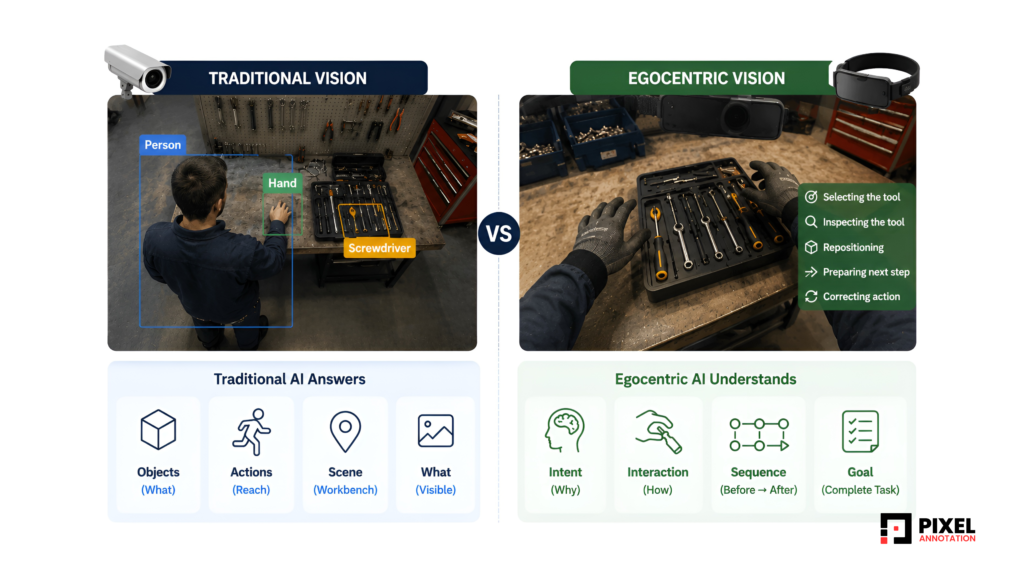
Traditional computer vision asks:
What is happening in this scene?
Egocentric AI asks:
What is the person trying to do?
Consider a simple example. A person reaches toward a screwdriver.
From a single frame, the AI cannot determine whether the person is:
- Selecting the tool,
- Inspecting it,
- Repositioning it,
- Preparing for the next task,
- Or correcting a previous action.
The visual information may look identical. The meaning behind it is completely different. This is why egocentric AI focuses not only on objects but also on actions, interactions, intentions, and workflows.
#Why Robotics Is Driving This Category
While egocentric AI has applications across healthcare, AR/VR, industrial operations, and sports, robotics is where its importance becomes most apparent.
For a robot to operate effectively in the real world, object detection alone is not enough.
The robot needs to understand:
- how humans manipulate objects,
- how tasks are performed,
- how actions transition,
- and how successful outcomes are achieved.
The most effective way to teach this is through first-person data captured from someone performing the task.
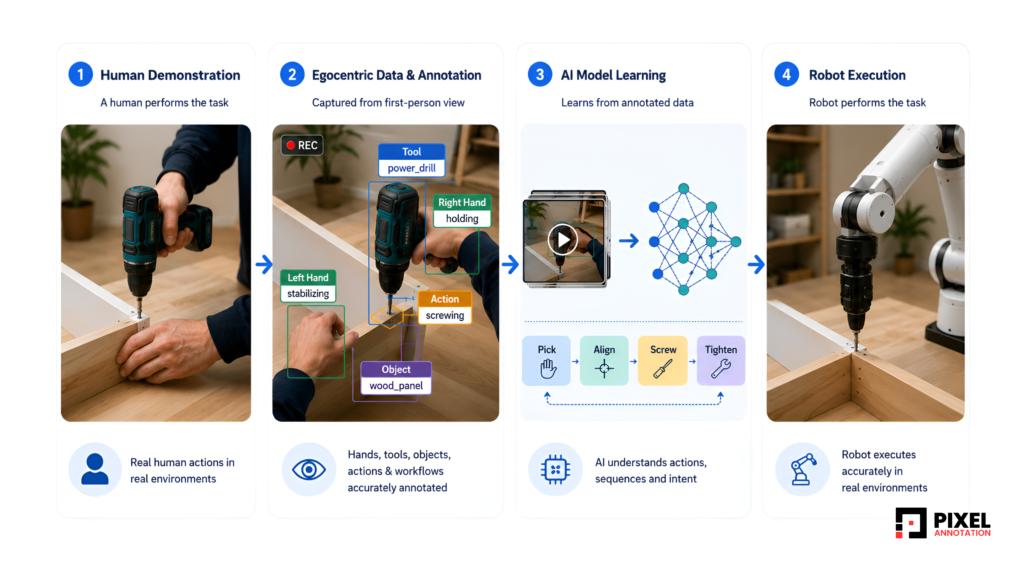
This forms the foundation of:
- Imitation learning
- Embodied AI
- Robotic manipulation
- Human-robot collaboration
The quality of the egocentric datasets being built today will directly influence how capable these systems become.
#Why Egocentric Data Requires Specialized Annotation
Unlike traditional datasets, egocentric data captures actions, interactions, intent, and workflows from a first-person perspective.
This requires a fundamentally different annotation approach.
* Continuous Perspective Changes
Because the camera moves with the person, every head movement changes the viewpoint.
Egocentric datasets frequently contain:
- Rapid camera motion
- Dynamic perspectives
- Partial visibility
- Constantly changing environments
Accurate annotation requires understanding how actions evolve over time rather than simply labeling individual frames.
* Human-Object Interactions
In egocentric AI, the most important information often comes from interactions rather than objects.
Examples include:
- Picking up a screwdriver
- Rotating a valve
- Tightening a fastener
- Assembling a component
- Inspecting a finished product
The objective is not simply to identify objects. The objective is to understand how humans interact with them.
* Temporal Understanding
A single frame rarely tells the complete story.
A hand touching an object may represent:
- selecting,
- positioning,
- inspecting,
- adjusting,
- preparing,
- or completing.
Understanding the surrounding sequence provides the context needed for accurate annotation.
This makes temporal understanding one of the most important components of egocentric AI.
* Action and Intent Understanding
Egocentric AI systems increasingly attempt to understand not just what actions occur, but why they occur.
For example:
A person reaching toward a tool may be:
- selecting it,
- inspecting it,
- repositioning it,
- correcting a previous step,
- or preparing for the next action.
The visual movement may be identical. The intention behind it is not.
Capturing these distinctions requires annotation approaches that incorporate contextual and workflow understanding.
* Multi-Modal Understanding
Many egocentric AI systems combine:
- Video
- Audio
- Gaze information
- Hand pose
- Body motion
- Sensor data
- Environmental context
As a result, annotation extends beyond visual labeling to include behaviors, interactions, sequences, and task understanding.
Organizations working with a specialized data annotation company can better manage these complex annotation requirements across multimodal AI datasets.
# What Does Egocentric Annotation Actually Involve?
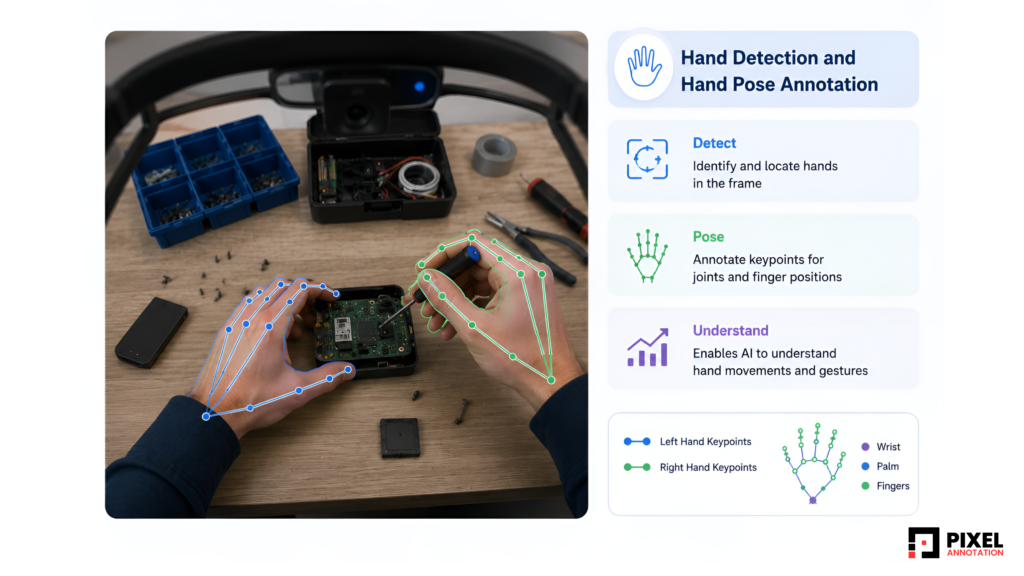
– Hand Detection and Hand Pose Annotation
Hands are the primary interface between humans and their environment.
Annotation tasks often include:
- Hand detection
- Hand tracking
- Finger keypoint annotation
- Hand pose estimation
Unlike conventional pose annotation, egocentric hand annotation frequently requires reasoning across occlusions, motion blur, and changing viewpoints.
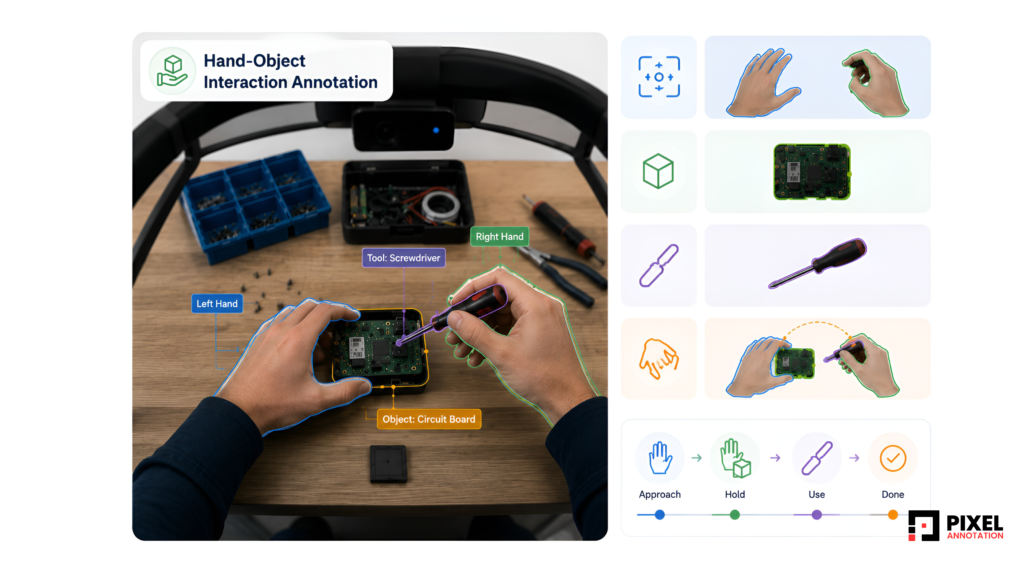
– Hand-Object Interaction Annotation
This is where egocentric annotation becomes particularly valuable.
Examples include:
- Grasping
- Holding
- Pushing
- Pulling
- Rotating
- Manipulating
- Assembling
- Inspecting
These interactions teach AI systems how humans manipulate the physical world.
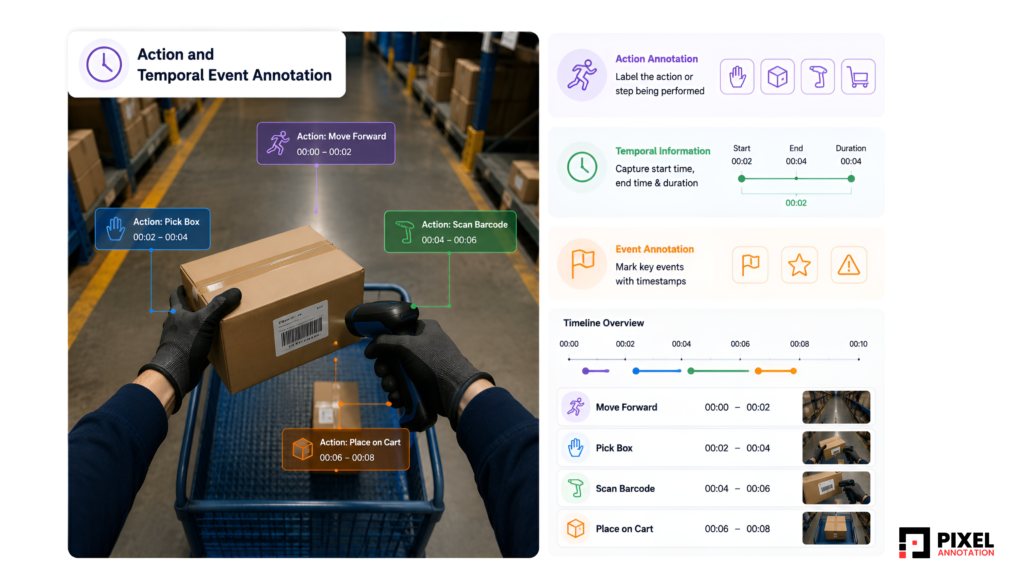
– Action and Temporal Event Annotation
Individual frames do not tell the story. Sequences do.
Imagine a worker assembling a component:
Reach → Grasp → Position → Adjust → Tighten → Verify
For humans, this sequence is obvious.
For AI, every action and transition must be explicitly annotated.
This includes:
- Action start
- Action continuation
- Action completion
- Action failure
- Action transitions
– Object State Annotation
Objects change state as humans interact with them. Examples include:
- Closed → Open
- Empty → Filled
- Loose → Tightened
- Unassembled → Assembled
- Locked → Unlocked
State annotations help AI understand whether an action was completed successfully.
– Workflow Annotation
One of the most valuable forms of egocentric annotation involves capturing complete workflows.
A typical workflow annotation may look like:
Locate Component
↓
Pick Component
↓
Inspect Component
↓
Position Component
↓
Assemble Component
↓
Verify Completion
This enables AI systems to learn not just isolated actions, but entire procedures.
# Why Domain Understanding Matters
Consider a manufacturing technician assembling a component. A generic annotation may identify:
Hand touches component. A domain-aware annotation may recognize:
- Component selection
- Orientation verification
- Alignment adjustment
- Torque application
- Completion verification
The visual scene is identical. The information captured by the annotation is not. Without domain understanding, labels may be visually accurate but operationally meaningless.
And AI systems trained on contextually incomplete data often struggle when faced with real-world complexity.
This is why successful egocentric annotation requires:
- Domain-specific guidelines
- Workflow understanding
- Temporal reasoning
- Context-aware annotation approaches
# The Future of AI Is First-Person
As AI continues to evolve toward:
- Embodied AI
- Robotics
- Smart glasses
- AR/VR systems
- Human-machine collaboration
- Physical AI
the ability to understand the world from a first-person perspective becomes increasingly important.
Teaching AI through egocentric data is not simply about showing machines what humans see.
It is about helping machines understand:
- what humans do,
- how they do it,
- and why they do it.
And that understanding begins with high-quality egocentric data annotation.
At Pixel Annotation, we support AI teams building next-generation egocentric and embodied AI systems through specialized annotation services for:
✓ Hand pose annotation
✓ Hand-object interaction annotation
✓ Temporal event annotation
✓ Workflow annotation
✓ Human activity understanding
✓ Robotics datasets
✓ Embodied AI training data
Because teaching AI through first-person vision requires more than annotation. It requires understanding human behavior.