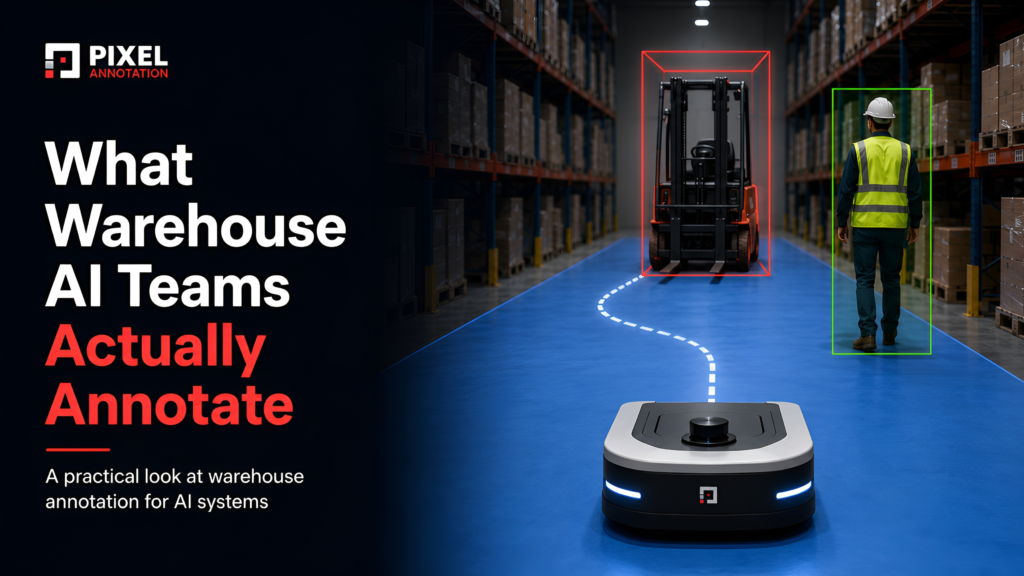
What Warehouse AI Teams Actually Annotate
What Warehouse AI Teams Actually Annotate AMR Navigation, Robotic Picking, Safety Analytics, and Inventory Scanning A pallet does not mean the same thing to every warehouse AI system. To an autonomous mobile robot, it is a 3D obstacle with a position, size, and direction. To a picking robot, it may be part of the background beneath the products. To a safety system, it can become a hazard when it blocks a pedestrian path. To an inventory drone, it may only matter because its presence confirms that a rack slot is occupied. The physical object has not changed. The decision being made about it has. This is where warehouse computer vision annotation becomes more complicated than it first appears. Navigation, picking, safety, and inventory systems often operate inside the same facility and observe many of the same objects. Yet each system needs those objects labelled differently. Teams that treat warehouse AI as one large annotation project usually discover the problem late. The ontology works for the first model, but the next system needs different boundaries, attributes, temporal information, or export formats. A better approach is to separate warehouse annotation into four clear label contracts. The four warehouse annotation systems Most warehouse annotation tasks for warehouse automation fall into four production systems: These systems may share cameras, footage, and object classes. They should not automatically share annotation rules. The right place to begin is not with the question, “What objects are visible?”It is:– What decision must the model make from this data? An autonomous mobile robot needs to decide where it can move. A picking system needs to decide which item it can grasp. A safety model needs to decide when an interaction becomes dangerous. An inventory system needs to decide what is present in a rack location. Once that decision is clear, the annotation requirement becomes much easier to define. 1. AMR navigation needs geometry, free space, and movement Autonomous mobile robots must understand the warehouse as a changing 3D environment. They need to recognise fixed structures, temporary obstacles, moving workers, forklifts, carts, pallets, and anything else that may affect the robot’s route. Good autonomous mobile robot training data normally combines camera images, depth data, LiDAR point clouds, and video, requiring different forms of image annotation depending on the perception task. The main annotation tasks are: Each task answers a different navigation question. – 3D cuboids describe where an obstacle exists A 2D box confirms that an object is visible. 3D cuboid annotation gives the model its location, dimensions, orientation, and position relative to the robot. Warehouse cuboid classes commonly include workers, forklifts, pallets, hand pallet trucks, carts, stillages, and small load carriers. The difficult part is rarely drawing a box around a clean object. It is deciding what the cuboid should contain when the object is partially visible or physically connected to something else. Consider a loaded pallet wrapped in plastic. Should the cuboid cover only the wooden pallet or the complete load? For navigation, the robot must avoid the entire structure, so labelling only the pallet base would underestimate the obstacle. Forklifts create similar problems. Their forks may extend well beyond the main body, sometimes close to the floor where they are difficult to see in an image. If one annotator includes the forks and another does not, the model receives two different definitions of the same vehicle. Practical guidelines should settle questions such as: These are not minor annotation details. They change the geometry the model learns. Teams searching for a pallet detection dataset LiDAR setup often focus first on the number of point clouds available. In practice, the more important issue is whether cuboid orientation, pallet-load boundaries, occlusion, and stack-height rules are applied consistently. – Free-space masks define where the robot may travel Obstacle detection explains what the robot should avoid. Free-space semantic segmentation explains where the robot can safely move. At first glance, warehouse floors seem easy to annotate. In real footage, several surfaces can look like obstacles or open space depending on lighting and camera angle. Annotators regularly encounter: A shadow should not become an obstacle simply because it is dark. A transparent sheet on the floor should not become free space simply because the concrete remains visible underneath it. This is where contextual judgement matters. The annotator must understand not only what is visible, but whether the robot can physically travel through that area. Clean warehouse footage rarely represents peak operations. Once cartons, temporary pallets, workers, wrapping material, and moving equipment enter the same aisle, the free-space problem changes completely. – Tracking IDs help the robot predict movement A person detector tells the robot that someone is present. A tracking ID tells it that the person in the current frame is the same person seen in previous frames. That continuity allows the system to estimate direction and speed. Without stable tracks, the robot may detect a worker in every frame but still fail to understand whether the worker is: Tracking becomes difficult when workers cross paths, move behind racks, are blocked by forklifts, or wear similar high-visibility clothing. The quality review therefore needs to examine sequences, not isolated frames. A box can be accurate in every frame while the identity changes incorrectly halfway through the track. An AMR dataset with strong detection labels but unstable IDs trains a robot that can see people without reliably anticipating them. 2. Robotic picking needs object boundaries and interaction labels Robotic picking is usually the most annotation-intensive warehouse system. Navigation models repeatedly encounter a controlled list of classes such as workers, forklifts, carts, and pallets. Picking systems may face thousands of product shapes, colours, materials, packaging types, and damage conditions. A bin that looks simple to a person may contain overlapping products, transparent packaging, reflective surfaces, folded cartons, soft bags, and items partly buried beneath others. The main bin picking annotation tasks include: – Instance masks separate objects inside clutter Bounding boxes are often too broad for robotic picking. When products touch or overlap, two boxes may
What Warehouse AI Teams Actually Annotate Read Post »