pixelannotation.com

Uncategorized

Data Annotation, image annotation

How AI Learns to Read Floor Plans and Plot Maps: Annotation for the Built World

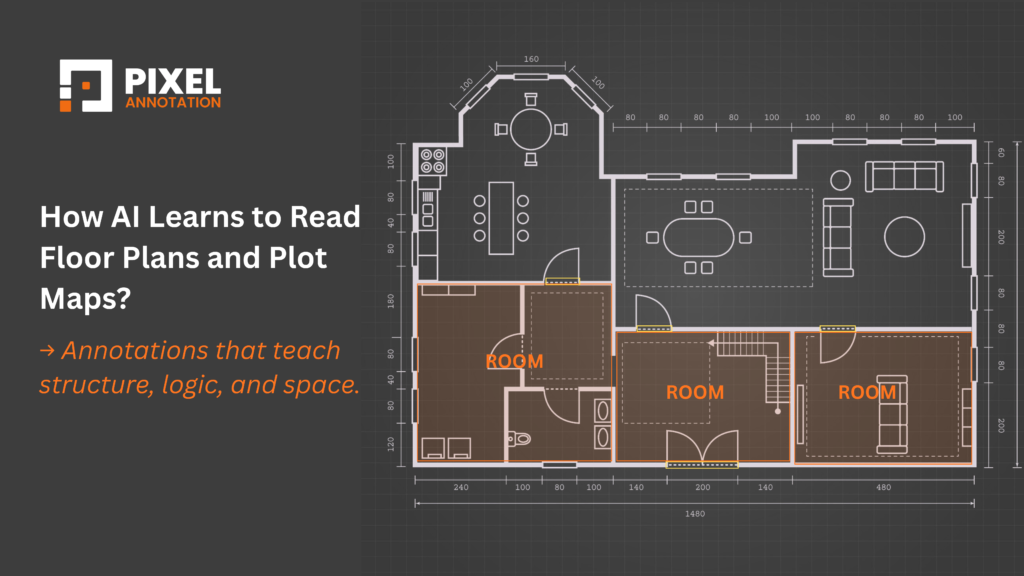
How AI Learns to Read Floor Plans and Plot Maps: Annotation for the Built World Civil drawings are the DNA of the built world but to an untrained machine, they’re just lines on a page. Here’s how expert annotation bridges that gap, and why getting it wrong is not an option. Every civil drawing tells a story of a structure, a system, a space, and the intent behind it. Engineers read that story fluently. Planners, architects, and contractors navigate it daily. But AI? Without structured, expertly labeled training data, it sees nothing more than lines and shapes on a page. This gap between human interpretation and machine understanding is exactly where most AI development in the built environment stalls. And the teams that close it fastest aren’t the ones with the most computing power, they’re the ones with the best training data. Specifically, the ones who got annotation right. Expert annotation is what transforms a static civil drawing into something a machine can reason about. It’s how AI learns the difference between a load-bearing wall and a partition, a setback boundary and a utility line, a structural layer and a mechanical one. Without it, even the most sophisticated model is working blind. Civil Drawings Aren’t Just Images They’re a Language A photograph of a building tells you what something looks like. A civil drawing tells you what something means. That’s a fundamental difference and it’s the core reason AI struggles here without expert guidance. Architectural and civil drawings operate within a highly structured symbolic language. Every element from dashed boundary lines to section markers, hatching patterns to elevation notations carries a specific technical meaning. Meaning that shifts based on context, discipline, regional standard, and drawing type. “To a computer vision model, a load-bearing wall and a partition wall can look identical. To a trained annotator who understands construction, they are completely different objects with entirely different implications.” The variability compounds the challenge further. A notation style common in one state’s zoning department may be unrecognizable to a model trained on another. This isn’t a limitation that better algorithms alone can fix. It requires humans who understand the domain to teach the machine systematically, precisely, and at scale. What AI Actually Needs to Learn from These Drawings Before anyone annotates a single line, it’s worth being clear on what the model needs to understand. Because “reading” a floor plan isn’t one task it’s many, layered on top of each other. A capable AI model for civil drawing interpretation must be able to: None of this is achievable with generic object detection or out-of-the-box computer vision. Each capability requires training data that specifically reflects these distinctions which means annotations built by people who instinctively understand what they’re looking at. The Annotation Toolkit: How We Actually Label These Drawings There’s no single annotation approach that works across all drawing types and use cases. Effective annotation for civil and architectural AI requires a layered, technique-driven strategy. Here’s what that looks like in practice. Bounding Boxes Locating What Matters We use bounding box annotation to identify discrete elements like directional arrows, legend symbols, reference tags, and elevation markers. This forms the foundation for symbol detection models and OCR alignment helping the AI learn to filter out decorative or informational elements from structural ones before deeper analysis begins. Polygon Annotation Defining Spatial Geometry Floor plans demand pixel-perfect precision. Polygon annotations isolate rooms, corridors, balconies, doors, and external boundaries with exact geometry enabling the model to calculate spatial relationships, proximity, and layout logic. These annotations are also the primary input for converting 2D plans into layered 3D BIM-compatible data. Polyline Annotation Mapping Continuous Systems Utility systems don’t exist as isolated objects. Water pipelines, electrical conduits, and fire egress routes run continuously across entire plans. Polyline annotations capture this flow enabling AI to trace pathways, segment zones, and support routing algorithms for both design validation and infrastructure inspection. Custom Ontologies Built for Your Domain No two clients work from identical standards. We collaborate with AI teams to build custom class schemas and annotation taxonomies tailored to specific zoning frameworks, real estate classification systems, or regulatory environments. Your model learns within a logic structure that reflects the domain it will operate in not a generic approximation of it. Why Human Expertise Is Non-Negotiable Here There’s a common assumption in AI development that annotation is a task you can optimize away automate it, crowdsource it, get it “good enough.” In most domains, that works. In civil and architectural drawings, it doesn’t. Domain literacy is irreplaceable. You cannot label what you don’t understand. A dashed line might indicate a setback boundary on a site plan and an overhead soffit on a floor plan. Knowing which requires familiarity with construction conventions not just visual pattern recognition. Context changes meaning. The same symbol carries different meanings across drawing types, project phases, and jurisdictions. Automated tools cannot reliably make these contextual distinctions. Experienced annotators can. Layers must be separated intelligently. Distinguishing a structural element from a mechanical one when they overlap in the same drawing space requires judgment. Mislabeling at this layer cascades into model errors at every downstream task. The stakes are high. A mislabeled access point or misidentified utility line can produce errors in AI-generated permit assessments, compliance checks, or site safety analyses. In this domain, annotation quality directly correlates with real-world risk. “Good annotation in civil drawings doesn’t just label data. It encodes the judgment of experienced professionals into a format that AI can learn from.” Where This Work Gets Applied Real Use Cases Annotated civil drawings aren’t an academic exercise. They’re actively powering real AI applications across some of the fastest-growing sectors in infrastructure and construction technology. Urban Planning & Plot Digitization City governments and planning commissions are using annotated site maps to digitize land records at scale mapping property boundaries, validating zoning compliance, and accelerating the review of construction proposals that previously took weeks to process manually. Construction Monitoring & Compliance By comparing annotated blueprints against as-built photographs,

, , ,

How AI Learns to Read Floor Plans and Plot Maps: Annotation for the Built World Read Post »
Data Annotation, image annotation, Uncategorized

Autonomous Vehicles Don’t Fail Because of Algorithms They Fail Because of Data

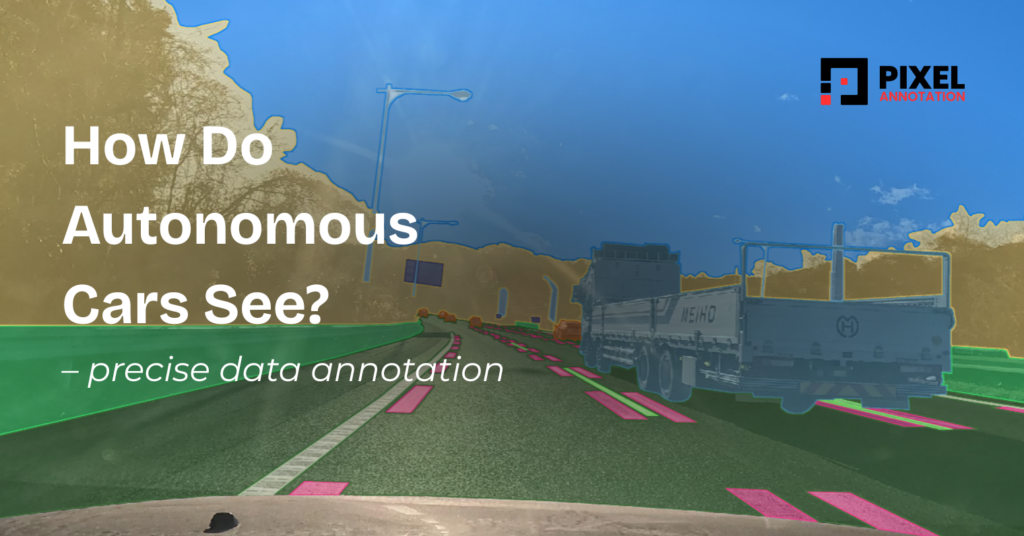
Autonomous Vehicles Don’t Fail Because of Algorithms They Fail Because of Data Autonomous vehicles are often discussed in terms of advanced sensors, powerful GPUs, and cutting-edge algorithms. But in real-world deployments, failures rarely happen because a model is mathematically weak. They happen because the model misunderstands the environment. And that misunderstanding almost always traces back to one thing: data annotation. Before an autonomous system can make decisions, it must first perceive the world correctly. That perception is entirely dependent on how well raw sensor data is labeled, structured, and validated. This is where AI data annotation services play a critical role. In autonomous driving, annotation is not a supporting step, it is the foundation. From Raw Sensors to Machine Understanding An autonomous vehicle does not see roads, pedestrians, or traffic signals the way humans do. It sees: On their own, these inputs carry no meaning. Annotation converts this raw data into structured ground truth, allowing models to learn what exists in the scene, where it is, and how it behaves over time. Without accurate image labelling and validation, even the most advanced perception models struggle in real-world driving conditions. What Autonomous Annotation Really Involves Autonomous annotation is not a single task. It is a combination of multiple annotation techniques that work together to support perception, prediction, and planning modules. Bounding Boxes: Identifying Objects in the Scene Bounding box annotation is used to localize objects such as vehicles, pedestrians, cyclists, traffic signs, and signals. It answers a basic but critical question: what objects are present and where are they located? For any image annotation company in India working with autonomous datasets, consistency and accuracy at this stage are essential. Poorly aligned boxes or inconsistent class definitions directly impact object detection performance. Segmentation: Pixel-Level Understanding of the Environment While bounding boxes identify objects, segmentation explains the scene at a much deeper level. Image segmentation enables autonomous systems to understand: At Pixel Annotation, segmentation is handled as pixel-level object detection, where precision matters at the smallest scale. As part of our image segmentation annotation service, we deliver: Points We Consider During Segmentation Annotation This approach is critical for AI image segmentation services in India, where autonomous models demand high-fidelity data. Even small segmentation errors can result in incorrect path planning or unsafe navigation decisions. Our Image Segmentation Services in India are designed to meet the precision requirements of safety-critical autonomous applications. 3D Annotation: Adding Depth and Spatial Awareness Camera images alone cannot provide accurate distance or scale information. Autonomous systems rely on 3D annotation using LiDAR data to understand spatial relationships. 3D cuboidal annotation captures: This spatial awareness is essential for collision avoidance, lane merging, and speed control making it a core part of advanced AI data annotation services for autonomous mobility. Why Manual Annotation Is Still Critical for Autonomous Vehicles Automation and model-assisted labeling can improve speed, but they cannot replace human precision, especially in autonomous driving where the margin for error is extremely small. No model is 100% accurate. Automated systems may miss partially visible pedestrians, mislabel complex boundaries, or fail in rare edge cases. This is why manual annotation remains essential. At Pixel Annotation, all datasets are annotated by trained human annotators and reviewed through a dedicated quality assurance process, where each and every annotation is carefully validated. Consider a real-world scenario:If a model skips labeling a pedestrian due to occlusion or poor lighting, the model trained on that data may fail to detect similar pedestrians in real traffic. In autonomous systems, this is not a minor error, it can result in incorrect perception, delayed response, or unsafe outcomes. This is where experienced human annotators and QA workflows demonstrate their value. Manual annotation ensures critical objects are never overlooked, even in complex or ambiguous scenes. Why Annotation Quality Directly Impacts Safety Every perception module — object detection, segmentation, tracking, and prediction — depends on accurate ground truth data. Poor annotation leads to: High-quality annotation creates models that generalize better and behave more predictably in real-world environments. Pricing Model for Autonomous Vehicle Annotation Our pricing for autonomous vehicle annotation is per annotation, not one-size-fits-all. The cost depends on: This flexible approach ensures clients pay based on the actual annotation effort and quality level needed, rather than a generic flat rate. Conclusion Autonomous driving is not enabled by algorithms alone. It is enabled by accurately labeled, carefully validated data. As an experienced image annotation company in India offering end-to-end AI data annotation services, Pixel Annotation focuses on precision, scalability, and quality, especially for safety-critical use cases like autonomous vehicles. From AI image segmentation services in India to large-scale autonomous datasets, we approach annotation as a responsibility, not just a service.

, , , , ,

Autonomous Vehicles Don’t Fail Because of Algorithms They Fail Because of Data Read Post »

KeyPoint Annotation Human Tracking
Uncategorized

How KeyPoint Annotation Works in Pose Estimation and Human Tracking 

How KeyPoint Annotation Works in Pose Estimation and Human Tracking  Ever watched a fitness app track your workout form with impressive accuracy? Or wondered how autonomous vehicles can distinguish between a person standing still versus someone about to cross the road? Behind these remarkable abilities lies a fundamental technique which is keypoint annotation for pose estimation.  KeyPoint annotation has helped countless companies transform raw visual data into intelligent systems that understand human movement. In this guide, we’ll take you behind the scenes of keypoint annotation, showing you not just what it is, but why it matters and how it powers the technology you interact with daily. Understanding Pose Estimation: The Foundation   Imagine giving a computer the ability to recognize not just that a person exists in an image, but exactly how they’re positioned—their stance, the angle of their limbs, even subtle gestures. That’s precisely what pose estimation accomplishes.  Pose estimation is a computer vision technique that detects human body positioning by identifying and tracking specific points on the body. These points—called keypoints, typically include joints and facial features such as:  When these points are connected, they create a skeletal representation that moves with the person, giving machines a way to “see” human movement.  Two Dimensions vs. Three: Types of Pose Estimation  Pose estimation comes in two primary varieties:  Processing Approaches: Top-Down vs. Bottom-Up  When implementing pose estimation, two technical approaches dominate:  Top-Down Approach:  Advantage: Often more accurate for individuals  Challenge: Processing time increases with each person detected  Bottom-Up Approach:  Advantage: Processing time remains consistent regardless of how many people appear  Challenge: Can struggle with complex, overlapping poses What is Keypoint Annotation? The Human Touch Behind Machine Vision  For machines to recognize body positions accurately, they need training data—thousands or even millions of examples of properly marked human poses in various positions, lighting conditions, and environments.  Keypoint annotation is the meticulous process of marking these critical points on images and videos, creating the “ground truth” that teaches AI systems to recognize human posture and movement. Keypoint detection algorithms can only be as accurate as the data they learn from, which is why high-quality keypoint annotation is the cornerstone of effective pose estimation systems. The Keypoint Annotation Process: More Than Just Placing Dots  At Pixel Annotation, our keypoint annotation workflow is defined by precision and consistency:  Quality Assurance: Every annotation undergoes multiple review stages, with both automated checks and human verification ensuring anatomical correctness and adherence to project specifications. Why Quality Matters in Keypoint Annotation  Have you ever used an application that just couldn’t seem to track your movements correctly? Or a virtual try-on feature that misaligned with your body? Chances are, poor annotation quality was the culprit.  At Pixel Annotation, we’ve seen firsthand how the quality of keypoint annotation directly impacts model performance:  That’s why we invest heavily in annotator training, quality control processes, and specialized keypoint labeling tools—because we know your AI can only be as good as the data it learns from. Real-World Applications: Where Your Annotated Data Makes an Impact  The keypoint data we help create powers innovations across numerous industries:  Physical Therapy  Fitness & Sports Analysis  Retail & Shopping  Security & Safety  Advanced Keypoint Annotation Tools and Technologies  At Pixel Annotation, we leverage cutting-edge keypoint annotation tools that streamline the process while maintaining exceptional quality. Our comprehensive toolset includes:  These advanced keypoint labeling tools enable our annotators to work efficiently while adhering to the stringent quality standards required for effective pose estimation models. When you partner with us, you gain access not just to expert annotators but to an entire ecosystem of specialized annotation technology. The Pixel Annotation Difference: Why Partner With Us?  When you choose Pixel Annotation for your keypoint annotation needs, you’re not just outsourcing a task—you’re gaining a partner invested in your project’s success. Our approach combines technical precision with responsive service:  Transparent CommunicationYour project manager provides regular updates on progress, quality metrics, and any challenges encountered, keeping you informed throughout the annotation process. Beyond Basic Annotation: Advanced Keypoint Services  As your needs grow, our capabilities extend beyond basic keypoint placement:  For video data, we ensure consistency of keypoints across frames, enabling smooth tracking and analysis of movement over time.  We specialize in complex scenes with multiple people interacting, maintaining keypoint accuracy even with overlapping subjects.  From sports-specific movements to medical applications, we develop specialized keypoint configurations tailored to your industry’s unique requirements. Conclusion In a world where machines are increasingly expected to understand and interact with humans, keypoint annotation stands as a critical enabler of that intelligence. From improving patient care and workout performance to enhancing virtual experiences and public safety, the precision and quality of annotated data are what set exceptional AI systems apart. At Pixel Annotation, we combine domain expertise, cutting-edge tools, and a commitment to accuracy to deliver data that fuels real innovation. Whether you’re just getting started or scaling to millions of images, our team ensures that your models are built on a foundation of trusted, high-quality annotations. Let’s bring clarity to your computer vision models. Get in touch to explore how we can support your pose estimation and human tracking projects. ALSO READ : Sports Data Annotation: The Rise of AI and Data Annotation in Sports

, , , , , ,

How KeyPoint Annotation Works in Pose Estimation and Human Tracking  Read Post »

Scroll to Top